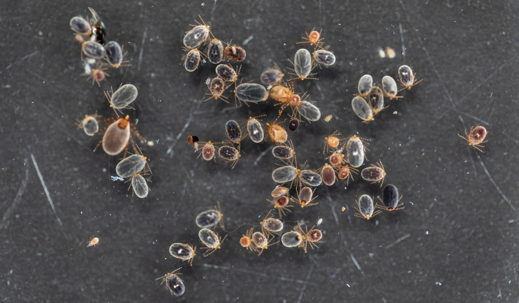
Tick Larvae vs. Nymphs: How to Tell the Difference
Finding a tiny tick on your skin, clothing, or pet can raise an immediate question: is it a larva or a nymph?
The difference matters because ticks change in size and appearance as they develop. Larvae have six legs. Nymphs have eight. Both stages are small enough to overlook, and both may appear around yards, pets, wildlife routes, or indoor spaces depending on the tick species.
Correct identification can help you describe what you found, improve your inspection, and decide whether routine prevention is enough or professional support may be useful. This guide explains how to compare tick larvae and nymphs without overstating what a single sighting can tell you.
Key Takeaways: Tick Larvae vs. Nymphs
- Most ticks pass through four life stages: egg, six-legged larva, eight-legged nymph, and adult.
- Leg count is the clearest difference: larvae have six legs, while nymphs have eight.
- Both stages are very small. Larvae are often described as seed ticks, while nymphs may be roughly poppy-seed sized depending on the species.
- A tiny tick is not enough to identify the species with confidence. Size, color, shape, location, host, and professional identification may all matter.
- Pets can bring ticks indoors after outdoor activity, so daily tick checks are an important prevention step.
- Brown dog ticks deserve special attention because they can live inside homes and other structures.
- Yard maintenance can reduce exposure: mow tall grass, remove leaf litter, clear brush, and monitor areas where pets and people spend time.
- If a tick is attached to skin, remove it promptly with tweezers and follow current CDC guidance.
How to Tell Tick Larvae and Nymphs Apart
The fastest way to compare a larva and a nymph is to count the legs. The CDC guide to tick life cycles explains that most ticks develop through four stages: egg, six-legged larva, eight-legged nymph, and adult.
This distinction sounds simple, but it can be difficult to apply in practice. Larvae and nymphs are tiny, legs may overlap, and a moving tick can be hard to examine closely. Use magnification when possible and avoid handling a tick with bare fingers.
Tick larvae have six legs
Larvae hatch from eggs with three pairs of legs. They are the first active stage in the tick life cycle and need a blood meal before they can molt into nymphs.
Because larvae are so small, they may look like moving specks at first glance. A cluster of tiny ticks can be especially difficult to identify without a closer inspection.
Tick nymphs have eight legs
Nymphs have four pairs of legs, like adult ticks. They are larger than larvae but smaller than adults.
The size varies by species, so avoid relying on size alone. A tiny eight-legged tick may be a nymph, but species identification often requires a clearer view of the body and other features.
Adults also have eight legs
An eight-legged tick is not automatically a nymph. Adult ticks also have eight legs. Adults are usually larger, but feeding can change a tick’s size and shape significantly.
When the life stage remains unclear, take a clear photo and request professional identification rather than guessing.
Why Tick Life Stages Matter
Ticks need blood meals as they develop. The CDC notes that most ticks must feed at every active stage to survive. After feeding, a larva molts into a nymph, and a nymph molts into an adult.
Life-stage identification can help you understand what you are seeing, but it does not answer every question. The tick species, where it was found, whether it was attached, and whether you are seeing repeated activity all matter.
Life stage does not confirm the species
Several tick species may appear in residential environments. A six-legged larva from one species may look similar to a larva from another species. The same problem applies to nymphs.
Do not assume that a poppy-seed-sized tick belongs to a particular species without a reliable identification.
Host patterns vary by species
Some larvae commonly feed on smaller hosts, while some nymphs and adults feed on larger animals. However, host use varies by species.
Avoid treating host preference as a rule that applies to every tick. A professional can help interpret the sighting in the context of your property, pets, and local conditions.
Brown dog ticks can create indoor problems
The UF/IFAS profile of the brown dog tick explains that this species is a three-host tick: each active stage feeds once, leaves the host, and then molts or lays eggs. Brown dog ticks are especially relevant around homes because they can complete their life cycle indoors.
If you repeatedly find ticks near pet bedding, baseboards, kennels, crates, or rooms where a dog spends time, request an inspection rather than assuming the issue is limited to the yard.
What Do Tick Larvae Look Like?
Tick larvae are the first active stage after the egg. They are tiny and can be hard to see without magnification.
Six legs
The defining feature is the leg count: three pairs, for a total of six legs.
When a tick is moving or attached to a host, the legs may be hard to count. Use a clear photo or magnification when possible.
Very small size
Larvae may be described as seed ticks because of their tiny size. A single larva can be easy to miss on fur, socks, shoes, or clothing.
A group of tiny ticks does not automatically mean every insect is a larva. Identification still matters.
May appear after contact with outdoor habitats
Larvae may be encountered after contact with grassy, brushy, wooded, or wildlife-used areas. Pets can also carry ticks indoors after outdoor activity.
Check clothing, skin, and pets carefully after spending time outside.
What Do Tick Nymphs Look Like?
Nymphs are the stage between larvae and adults. They have already completed one blood meal and molt.
Eight legs
Nymphs have four pairs of legs, for a total of eight.
This is the clearest difference from larvae. However, adult ticks also have eight legs, so consider body size and other identification features as well.
Small enough to overlook
Nymphs can be easy to miss on skin, clothing, or pet fur. The CDC notes that ticks may blend into hair and other areas of the body, which is why careful tick checks matter after outdoor activity.
Do not rely on a quick glance. Use a mirror or ask for help checking hard-to-see areas when appropriate.
Can attach to people and pets
Nymphs can attach to vertebrate hosts, including people and animals. Their small size makes prompt checks especially important after time outdoors.
Finding one attached tick does not prove that your yard has a large infestation, but repeated encounters justify a closer look at outdoor conditions and pet exposure.
Where Tick Larvae and Nymphs May Show Up
The location of a sighting can provide context, but it does not identify the life stage or species by itself.
On pets after outdoor activity
Dogs and cats that spend time outdoors can pick up ticks. The CDC guidance for preventing ticks on pets recommends checking pets daily for crawling or attached ticks.
Pay attention to areas where ticks may be harder to notice, including around the ears, beneath the collar, between the legs, around the tail, and between the toes.
Ask your veterinarian which tick-prevention product is appropriate for your pet. Do not apply a product to an animal unless the label and your veterinarian’s guidance support that use.
On clothing and skin
Ticks can attach after contact with grassy, brushy, or wooded areas. Check your clothing and body after outdoor activity.
The CDC prevention guidance recommends checking for ticks after coming indoors, showering within two hours when possible, and using a dryer on high heat for dry clothing.
In pet bedding or resting areas
Ticks near pet bedding deserve closer attention, especially when sightings continue. Brown dog ticks can live inside structures and may be associated with kennels, crates, bedding, or rooms used by dogs.
Wash pet bedding according to the care label and inspect the surrounding floor, baseboards, and cracks.
Along yard edges and shaded areas
Ticks often remain in outdoor areas where they can encounter hosts. Tall grass, leaf litter, brush, wooded borders, and shaded ground cover can increase exposure.
Routine yard maintenance can make these areas less favorable and easier to monitor.
Do Tick Larvae and Nymphs Create Different Health Risks?
Both stages feed on blood, but risk depends on the species, location, pathogen, and individual exposure. Avoid assuming that every larva or nymph carries disease.
The CDC overview of ticks and tickborne disease explains that ticks in the United States can spread bacteria, viruses, and parasites that cause illness. However, the presence of a tick does not mean transmission has occurred.
Why nymphs deserve attention
Nymphs are small and may remain unnoticed on skin. This can make them harder to detect during a quick check.
Prompt inspection and removal matter more than trying to judge risk from size alone.
Larvae also require care
Larvae are smaller than nymphs and may be difficult to identify. Do not dismiss them simply because they are tiny.
If you find multiple small ticks on a person or pet, remove them carefully and consider requesting professional guidance.
Watch for symptoms after a bite
If you develop symptoms after a tick bite, contact a healthcare professional. CDC guidance advises seeking medical care when symptoms such as rash or fever develop within several weeks after a bite.
For pet symptoms or concerns, contact your veterinarian.
How to Remove an Attached Tick Safely
Remove an attached tick as soon as possible. The CDC instructions for tick removal recommend using fine-tipped tweezers to grasp the tick as close to the skin as possible.
Step 1: Use tweezers
Use fine-tipped tweezers when available. Grasp the tick close to the skin surface.
Step 2: Pull upward steadily
Pull upward with steady, even pressure. Do not twist or jerk the tick.
Step 3: Clean the area
After removal, clean the bite area and your hands with soap and water, rubbing alcohol, or another appropriate method recommended by CDC guidance.
Step 4: Avoid ineffective removal methods
Do not use petroleum jelly, heat, nail polish, or other substances in an attempt to make the tick detach. CDC cautions that these methods may agitate the tick.
Step 5: Seek care when needed
Contact a healthcare professional when you have questions about a tick bite or develop symptoms. Contact a veterinarian when a pet has an attached tick or concerning symptoms.
How to Reduce Tick Exposure Around Your Yard
Yard changes cannot eliminate every tick, but they can reduce favorable habitat and make outdoor spaces easier to monitor.
Remove leaf litter
Clear leaf piles and organic debris from areas where people and pets spend time. The EPA tips for preventing tick bites recommend reducing leaf litter and mowing tall grass or brush that may serve as tick habitat.
Mow tall grass and trim brush
Keep grass maintained and reduce overgrown vegetation along walkways, play areas, fence lines, and pet routes.
Focus on the areas your household uses rather than assuming every section of the yard needs the same level of attention.
Monitor yard edges
Ticks may be more common near brushy borders, wooded edges, and shaded ground cover. Check areas where a maintained lawn meets denser vegetation.
Check pets daily
Inspect pets after outdoor activity and use veterinarian-recommended prevention. A pet can bring a crawling tick indoors before the tick attaches.
Use repellents as directed
Use an EPA-registered repellent labeled for ticks when appropriate and follow the product instructions. Do not apply human insect repellent to a pet unless the label explicitly allows it and your veterinarian recommends it.
What Not to Do When You Find Ticks
Do not rely on size alone
Size can help, but it does not confirm the life stage or species. Feeding changes a tick’s appearance, and several species may look similar when immature.
Do not assume every tiny tick is a nymph
Larvae can also be extremely small. Count the legs when possible and request identification when the stage remains unclear.
Do not ignore repeated indoor sightings
One tick may have arrived on a person or pet. Repeated sightings near pet bedding, baseboards, kennels, or indoor cracks may indicate a broader issue, especially with brown dog ticks.
Do not use home remedies to detach a tick
Do not use heat, petroleum jelly, nail polish, or other substances to force a tick to release. Follow CDC removal guidance instead.
Do not rely only on pesticide spraying
The CDC tick-prevention guidance notes that outdoor pesticide use can reduce ticks in treated areas but should not be your only strategy. Yard maintenance, tick checks, pet prevention, and prompt removal remain important.
When to Request Professional Tick-Control Support
An isolated tick sighting may call for careful removal and monitoring. Professional support becomes more useful when encounters continue, several areas show activity, or the source remains unclear.
Consider requesting an inspection when:
- You keep finding ticks on pets, clothing, or family members.
- You find clusters of tiny ticks and cannot identify the life stage.
- Ticks continue appearing indoors near pet bedding, crates, kennels, or baseboards.
- You suspect brown dog tick activity inside the home.
- Your yard has dense vegetation, leaf litter, wildlife traffic, or shaded areas that are difficult to manage.
- You want help distinguishing an isolated sighting from a broader property issue.
Native Pest Management provides tick-control services in Florida. Its tick guide notes that the company provides tick control in cities including West Palm Beach, Port St. Lucie, Miami, Fort Lauderdale, and Tallahassee.
What a professional inspection should cover
A professional inspection should assess the location of sightings, pet-resting areas, baseboards, cracks, kennels, yard edges, leaf litter, shaded ground cover, and areas where wildlife or pets travel.
The goal is to identify the likely tick species, determine whether activity is indoors or outdoors, and recommend the appropriate next step.
What a tick-control plan may include
The right plan depends on the tick species and the areas supporting activity. Recommendations may include yard maintenance, monitoring, pet-focused prevention through your veterinarian, targeted treatment, and follow-up inspection.
A layered approach works better than relying on one method alone.
Bottom Line: Count the Legs, Then Look at the Bigger Pattern
Tick larvae have six legs. Tick nymphs have eight. That distinction is the clearest starting point when you are trying to identify an immature tick.
However, one tiny tick does not tell you everything. Consider where it appeared, whether it was attached, whether pets or wildlife may have carried it indoors, and whether sightings continue over time.
If ticks keep appearing or the source remains unclear, request a free quote from Native Pest Management to discuss tick activity around your property.
Frequently Asked Questions
How many legs do tick larvae have?
Tick larvae have six legs. After feeding and molting, they develop into nymphs with eight legs.
How many legs do tick nymphs have?
Tick nymphs have eight legs. Adult ticks also have eight legs, so leg count alone cannot separate nymphs from adults.
Are tick larvae smaller than nymphs?
Yes. Larvae are generally smaller than nymphs. However, size varies by species and changes after feeding, so avoid relying on size alone.
Can tick larvae bite people?
Tick larvae feed on blood, and host patterns vary by species. Do not assume a larva cannot attach to a person. Remove attached ticks promptly and follow CDC guidance.
Can pets bring tick larvae and nymphs indoors?
Yes. Pets can carry crawling or attached ticks indoors after outdoor activity. Check pets daily and ask your veterinarian which prevention product is appropriate.
Can brown dog ticks live inside a home?
Yes. Brown dog ticks can live inside homes and other structures. Repeated sightings near pet bedding, crates, kennels, or baseboards deserve closer attention.
What should I do if a tick is attached to my skin?
Use fine-tipped tweezers to grasp the tick close to the skin and pull upward with steady pressure. Clean the area afterward. Do not use heat, petroleum jelly, or nail polish to force the tick to detach.
When should I call a pest-control professional?
Request an inspection when tick sightings continue, clusters of tiny ticks appear, indoor activity develops near pet-resting areas, or the source remains difficult to identify.