Subterranean termite mud tubes in South Florida homes are the most reliable early sign of an active termite infestation. These pencil-width tunnels, built from soil, wood particles, and termite saliva, allow termite workers to travel from their underground colony to the wood inside your home without exposure to air or light. Finding a mud tube means a colony is already established somewhere on or near your property. In South Florida, where Formosan and Asian subterranean termites maintain colonies of millions of individuals that can forage up to 300 feet from their central nest, that colony may be far larger and more established than the tube alone suggests.
Key Takeaways
- Mud tubes are constructed from soil and saliva and run along foundations, walls, floor joists, and any surface connecting soil to wood. They are typically about the diameter of a pencil.
- Finding a mud tube does not automatically confirm an active infestation. UF/IFAS Extension notes that the presence of live termites is needed to confirm activity — a tube may be abandoned. Breaking a section and returning 24 to 48 hours later to check for repair confirms whether the colony is still active.
- South Florida is home to three subterranean termite species more destructive than those found in most of the country. Formosan and Asian subterranean termites form much larger colonies and cause structural damage significantly faster than the Eastern subterranean termite found in northern states.
What Mud Tubes Look Like and Where to Find Them
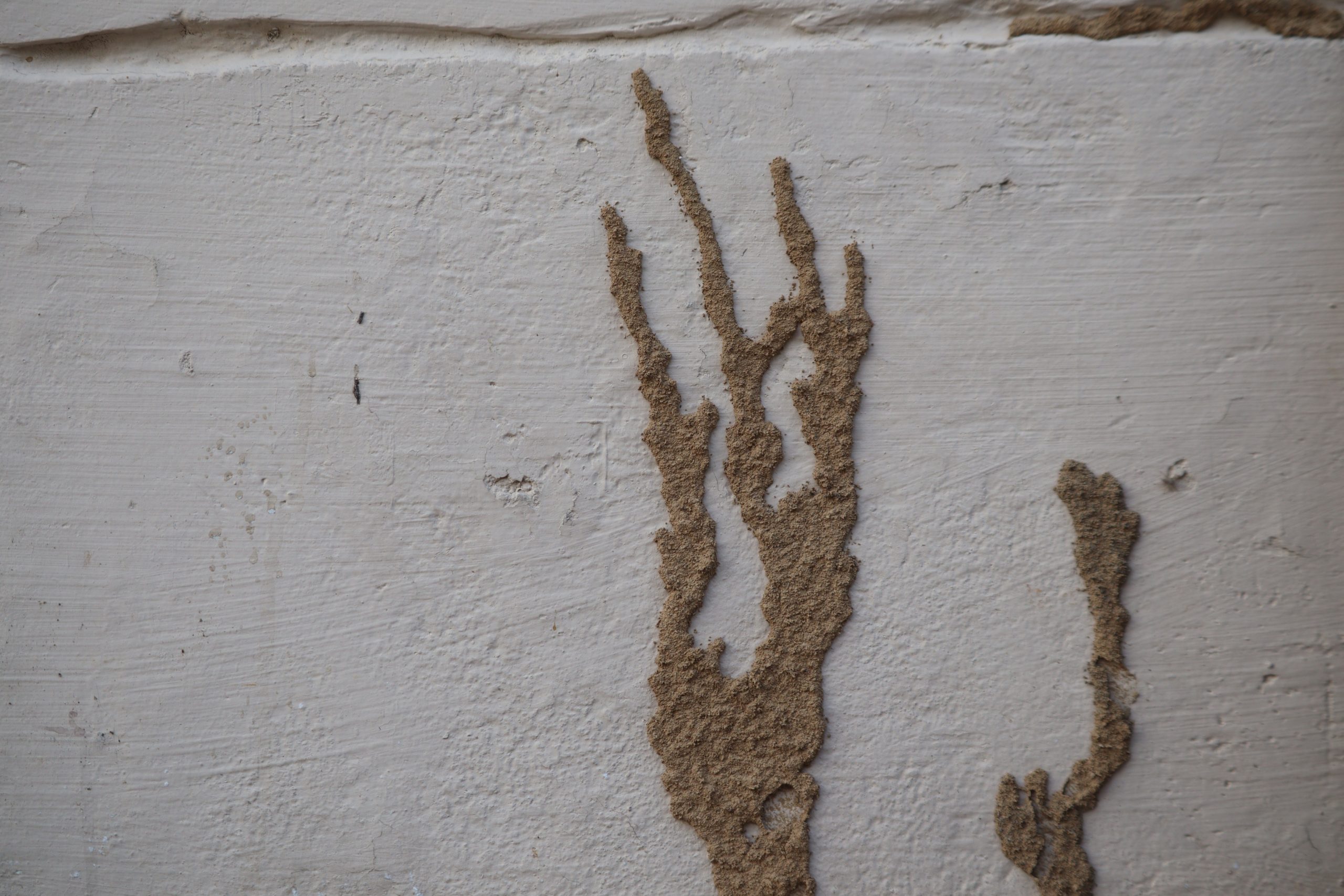
On a pale surface like a white foundation wall, mud tubes stand out immediately. On brick, rough concrete, or textured stucco, they can be missed entirely without a close inspection.
Physical Appearance
Mud tubes range from about the diameter of a pencil to the width of a thumb, depending on how long they have been in use and how heavily trafficked they are. They are brown, slightly rough-textured, and feel firm and dry to the touch. Their surface is irregular rather than smooth, reflecting the soil-and-saliva mixture that forms them.
Active tubes sometimes show slight moisture at their surface. Inactive or abandoned tubes are dry throughout. When broken open, an active tube will contain live workers, pale cream-colored insects about one-eighth of an inch long, moving rapidly through the channel.
Types of Mud Tubes
Not all mud tubes serve the same function. UF/IFAS Extension’s Formosan subterranean termite profile identifies foraging tubes as the most common type: the working tunnels termite workers build and maintain as they travel between the colony and food sources. These are the tubes most often found on foundation walls and exterior surfaces.
Exploratory tubes are thinner and more branching, built as termites probe for new food sources. They are often found extending from soil in random directions and may not connect to active feeding sites. Drop tubes hang downward from wood into open space, often spotted in attic spaces and floor voids. Swarm tubes are built specifically to allow reproductives to exit the colony during swarming events and tend to be wider and less structured than foraging tubes.
Where to Search on a South Florida Home
Foundation perimeter. Walk the exterior of the home at the base of the wall where it meets the grade. This is the most common location for mud tubes on slab-on-grade construction, which dominates South Florida residential building.
Garage walls and door frames. Garage slab edges and the framing around garage doors are frequent entry points because these areas often have wood-to-concrete contact with less inspection frequency.
Utility penetrations. Where pipes, conduit, and wires enter the foundation, termites exploit the gaps. UF/IFAS Extension’s subterranean termite publication notes that these entry points and expansion joints in concrete slabs are primary access routes into South Florida homes.
Attic spaces. Mud tubes found on attic rafters, trusses, and wall top plates indicate a well-established infestation that has worked its way up from the foundation over time.
Trees adjacent to the structure. UF/IFAS Monroe County Extension specifically recommends inspecting trees surrounding a structure for mud tubes on bark or at pruning wounds, as Formosan and Asian subterranean termites commonly infest live trees in urban South Florida and can use them as bridges to adjacent structures.
How to Confirm Whether a Mud Tube Is Active
The break-and-return test is the standard field method for confirming whether a tube is currently active.
The Break-and-Return Test
Break a one-inch section from the middle of a tube and inspect the opening for live termites. If workers or soldiers are present, the infestation is confirmed active. If none appear immediately, mark the break location and return in 24 to 48 hours. A repaired section confirms ongoing activity. No repair within that window suggests the tube may be abandoned, but it does not rule out active infestation elsewhere in the structure.
Why This Matters in South Florida
UF/IFAS Extension is explicit that mud tubes and wood damage can be indicative of subterranean termite activity, but the presence of live termites is needed to confirm an active infestation. This is particularly relevant in South Florida because the same structure may have both abandoned tubes from a previous treatment and active tubes from a new or ongoing infestation. Treating based on tubes alone without confirming activity can lead to unnecessary treatment or, worse, missing an active infestation in a different location.
What to Do When You Find a Mud Tube
A mud tube on a South Florida home foundation warrants a professional inspection, not a DIY spray.
Why DIY Treatment Doesn’t Reach the Colony
Breaking a tube and spraying the opening with a consumer product disrupts foraging activity temporarily but does not reach the underground colony. For Formosan termite infestations specifically, the carton nests built inside wall voids retain moisture independently of the soil, which means the colony can survive even if its soil connection is disrupted. Effective treatment must address the colony itself, not the visible tube.
What Professional Treatment Addresses
Subterranean termite treatment requires soil treatment with termiticide, bait station installation, or both, applied by a licensed pest control operator with experience in Florida’s specific termite species. Native Pest Management’s South Florida termite control team provides inspections, Sentricon bait station installations — which are specifically designed to eliminate the Coptotermes colonies most common in South Florida — no-tent termite treatments for localized infestations, and full tent fumigation for severe cases. As third-generation South Florida locals, their licensed termite technicians understand the species-specific patterns of Formosan, Asian, and Eastern subterranean termites across Miami-Dade, Broward, and Palm Beach counties. Free inspections available. New customers receive up to $300 off their first pest control service.
The Three Subterranean Termite Species Active in South Florida
The species present in a South Florida home determines how fast damage accumulates, how large the underground colony may be, and which treatment approach is most effective.
Formosan Subterranean Termite (Coptotermes formosanus)
The Formosan subterranean termite is the most destructive subterranean species in Florida and is particularly concentrated in South Florida’s coastal counties. UF/IFAS Extension identifies it as forming colonies of several million individuals that can cover over an acre of foraging territory. It is more aggressive and faster-moving than the Eastern subterranean termite. Formosan colonies build carton nests inside wall voids and other structural spaces — a compressed mixture of soil, wood pulp, saliva, and feces — in addition to the standard underground colony. This carton material within the structure allows the colony to retain moisture independently of the soil, which is why consumer sprays and surface treatments don’t reach or eliminate it.
Asian Subterranean Termite (Coptotermes gestroi)
The Asian subterranean termite is a close relative of the Formosan species and is found extensively in Miami-Dade, Broward, and Palm Beach counties. UF/IFAS Monroe County Extension notes that Asian subterranean termites begin swarming in early March in South Florida, earlier than Formosan termites. Their colonies also contain millions of individuals and forage at distances up to 300 feet from the central nest. Both Coptotermes species are classified as invasive in Florida and represent a more severe structural threat than the Eastern subterranean termite.
Eastern Subterranean Termite (Reticulitermes flavipes)
The Eastern subterranean termite is the most widely distributed species in North America and is present throughout Florida. It forms smaller colonies than the Coptotermes species, with workers foraging typically 50 to 60 feet from the nest per UF/IFAS Extension. While less aggressive, it is still a significant structural pest in South Florida and produces the same type of mud tube as its more destructive counterparts.
Why South Florida Homes Are at Elevated Risk
Three conditions specific to South Florida combine to make subterranean termite pressure here substantially higher than in most of the country: year-round colony activity, slab-on-grade construction, and a dense urban tree canopy that termites exploit as bridges.
Year-Round Activity
Unlike termite populations in colder climates that slow or become dormant in winter, South Florida’s warm temperatures keep subterranean termite colonies active throughout the year. UF/IFAS Extension’s termite prevention publication notes that Formosan subterranean termite colonies can cover foraging territories between one and one and a half acres. A colony active year-round covering that territory generates far more foraging pressure than a colony that experiences several months of cold-weather suppression.
Slab-on-Grade Construction
Most South Florida homes are built on concrete slabs rather than raised foundations with crawl spaces. Subterranean termites enter slab homes through expansion joints, cracks in the slab, and penetrations where utilities enter the structure. Mud tubes on these entry points are often the first and only visible warning before damage is already occurring inside wall framing.
Urban Tree Canopy
South Florida’s landscape, with its mature hardwoods, palms, and ornamental trees close to residential structures, gives subterranean termites additional habitat and access routes. UF/IFAS Extension research has documented that Formosan and Asian subterranean termites infest living trees in urban South Florida, often without visible external signs until the tree fails structurally. Trees adjacent to a structure that are infested can provide termites with direct access to the roofline and wall framing without requiring soil-to-foundation contact.
Schedule Your South Florida Termite Inspection
A mud tube on your foundation is one of the few visible signs of a pest that causes damage entirely out of sight. Native Pest Management’s licensed South Florida technicians can inspect your foundation perimeter, attic, and utility penetrations, confirm whether the infestation is active, and recommend the right treatment approach for the species present.
Schedule your free termite inspection with Native Pest Management.
Frequently Asked Questions
How do I know if a mud tube is active or abandoned?
Break a small section from the middle of the tube and check the opening for live workers. If none appear immediately, mark the break and return in 24 to 48 hours. A repaired section confirms active infestation. No repair does not definitively rule out termites — they may be active in other locations or have temporarily retreated.
Can I remove mud tubes myself to solve the problem?
Removing mud tubes does not treat the infestation. The tubes are a symptom of an underground colony that may contain millions of individuals. Breaking or scraping the tubes disrupts foraging temporarily, but workers will rebuild them and the colony continues feeding on the structure. Effective treatment reaches the colony itself, which requires professional application of soil termiticide or bait systems.
What’s the difference between Formosan termites and Eastern subterranean termites in terms of damage speed?
Formosan termite colonies are significantly larger and more aggressive. Eastern subterranean termites typically number in the hundreds of thousands with foraging ranges of 50 to 60 feet. Formosan colonies number in the millions and cover one to one and a half acres. UF/IFAS Extension notes that structural damage can occur within six months of a Formosan infestation. Eastern subterranean termite damage typically develops over a longer period.
Do mud tubes always mean termites are currently active inside my walls?
Not necessarily. Mud tubes confirm that termites have foraged through that location, but active feeding may be occurring at a different point in the structure. A tube on the exterior foundation does not confirm that wall framing inside is currently being consumed. A professional inspection that probes wall voids, checks floor joists, and assesses other structural elements gives a more complete picture of where active feeding is occurring.